
Merano and the Vinschgau
A Habsburg spa town, and behind it the driest valley in the Alps.
Merano was the cure town of the empire: from 1836, when the doctors of Vienna began sending lung patients there, it filled up with hotels, promenades along the river Passirio and gardens. Empress Elisabeth used to come, and the fact that the basin is sheltered by the mountains and that palm trees grow there did the rest.
What remains of that town are the winter and summer promenades on the two banks, the medieval arcades, the art nouveau Kurhaus and the baths, rebuilt in 2005. Three kilometres out are the gardens of Castel Trauttmansdorff, eighty botanical settings on a slope that looks down the valley: they take half a day, and they work with children.
The Vinschgau
From Merano the Vinschgau climbs west for sixty kilometres to the Resia pass, and it is the driest valley in the Alps: it rains so little that since the Middle Ages farming has depended on the Waalwege, the channels that carry glacier water to the fields, and the paths that run beside them are today perfectly level walks for anybody.
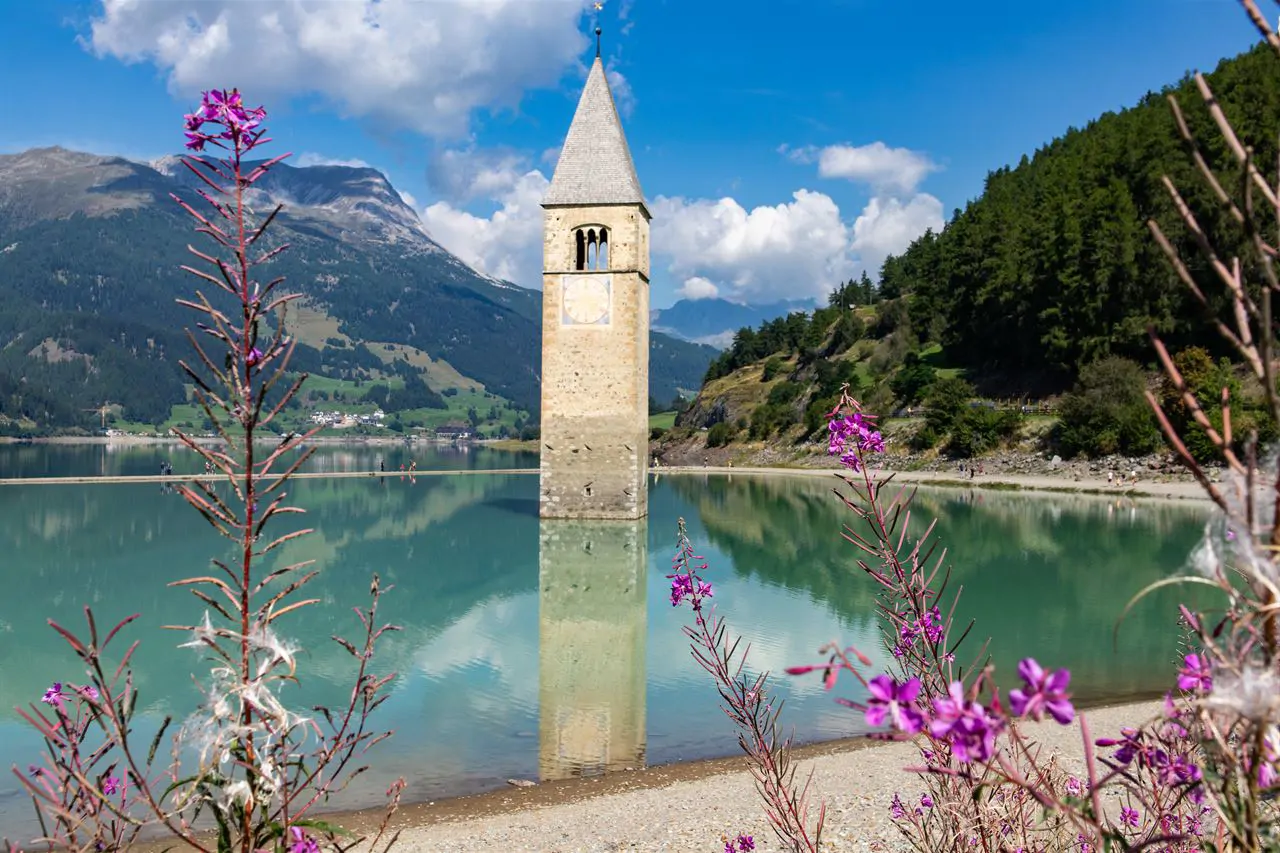
At the head of the valley is the lake of Resia, man made, created in 1950 by flooding the village of Curon: out of the water rises the bell tower of the old church, fourteenth century, and it is the image the valley is known for. Lower down stand Glorenza, which has a thousand inhabitants and a complete ring of walls, and Monte Maria abbey, Benedictine, the highest in Europe.
The Stelvio
From the Vinschgau you climb to the Stelvio national park and to the pass of the same name, which at 2,758 metres is the highest road pass in Italy: forty eight numbered hairpins on the South Tyrolean side, open from late May to October. Below, in Val Martello and Val di Solda, are the paths under the Ortles and the high altitude campsites.
The campsites of the area are around Merano, Lasa and Naturno, and they open for a long season: the Vinschgau cycle path, which follows the valley from Resia to Merano, is nearly all downhill and is done with the train that brings the bicycles back.